Injured at the Port of Redwood City? Contact the top Port of Redwood City accident attorney to pursue full compensation.
Working the docks along Redwood Creek carries real risk, and an injury at the Port of Redwood City does not fall under the same rules as an ordinary workplace accident. A misstep in the first few weeks after an injury can cost you tens of thousands of dollars in benefits or shut the door on a lawsuit against the party actually at fault.
The Law Offices of Charles D. Naylor represents injured port workers and their families across California and nationwide, and our entire practice sits inside admiralty law. We bring that single-minded focus to every claim we accept.
Get a free consultation and discover how our Port of Redwood City maritime attorneys can help you protect your recovery.
Why Port of Redwood City Injuries Need a Maritime Attorney
Port injuries fall under federal admiralty law, not California’s standard workers’ compensation system. Jones Act and the Longshore and Harbor Workers’ Compensation Act (LHWCA) govern these claims, and your employer’s insurance carrier knows these laws far better than most injured workers do.
A general personal injury attorney handles car accidents, not Jones Act negligence claims or LHWCA benefit disputes. Our firm focuses exclusively on admiralty and maritime law, and Our founder, Charles D. Naylor, has been named to the California Super Lawyers list, recognized as one of California Lawyer’s Attorneys of the Year, and honored with a CLAY Award for his work in maritime law.
Our results reflect that commitment. We have secured substantial jury awards and settlements for catastrophically injured maritime workers, and we have represented seamen, longshoremen, and dock workers at ports across California and nationwide for decades.
Call our 24/7 maritime injury hotline at (310) 514-1200, free, confidential, and no obligation.
What Accidents Happen at the Port of Redwood City
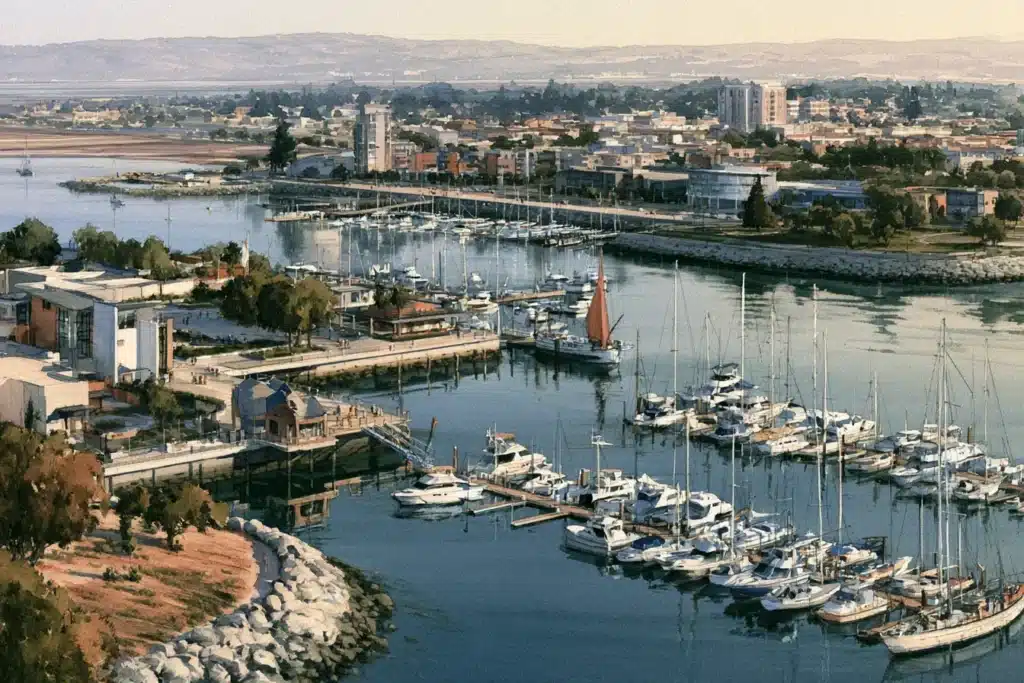
The Port of Redwood City, the only deepwater port on the South San Francisco Bay, moves bulk cargo, aggregates, scrap metal, and gypsum, along Redwood Creek. Operating cranes, heavy vessel traffic, and a constant flow of industrial trucks create conditions where a catastrophic injury can happen without warning.
Port accidents we handle include:
- Mooring line snapback: A line parting under extreme tension recoils in a fraction of a second, delivering fatal blunt-force trauma to anyone in the snapback zone.
- Crane and hoist failures: Dropped loads, rigging failures, and equipment rollovers are among the most common causes of catastrophic dock injuries.
- Slips and falls on docks and gangways: Oil, wet walking surfaces, and unsecured cargo lead to severe back, hip, and head injuries.
- Confined space incidents: Workers entering cargo tanks or holds without proper ventilation face life-threatening oxygen depletion and toxic chemical exposure.
- Tug and barge deck accidents: A sudden shift in vessel movement can throw a crew member overboard or into the path of moving machinery.
- Truck and yard vehicle strikes: UTRs, yard trucks, and container handlers move constantly through the terminal, putting pedestrian workers at serious risk.
One pattern we see consistently at smaller bulk-cargo ports like Redwood City is an assumption that a lighter shipping schedule means a lower-risk worksite, when in practice a smaller crew often means less redundancy and a longer wait for help after a crane or mooring line incident.
What we see again and again in confined-space incidents aboard bulk carriers is a worker who enters a cargo hold assuming a previous atmosphere test still applies, without realizing that oxygen and toxic gas levels can change significantly within just a few hours.
Are You a Jones Act Seaman or a Longshore Worker Under the LHWCA?
Which law covers you determines what compensation you can pursue and how. The Jones Act protects seamen, crew members with a substantial employment connection to a vessel in navigation. The Longshore and Harbor Workers’ Compensation Act covers land-based port workers, including longshoremen, crane operators, dock workers, and shipyard employees.
| Coverage | Who Qualifies | Key Remedy |
| Jones Act | Crew members with a substantial vessel connection | Right to sue for negligence, maintenance and cure |
| LHWCA | Longshoremen, shipyard workers, dock workers | Federal wage-loss and lifetime medical benefits |
| Section 905(b) | LHWCA workers injured by vessel negligence | Third-party lawsuit against the vessel owner |
Maintenance and cure is a seaman’s right to have their employer cover medical expenses and basic living costs throughout recovery, regardless of fault. Unseaworthiness holds vessel owners strictly liable for any unsafe condition aboard the ship or its equipment, even without proof of negligence.
The line between seaman and longshoreman status is not always clear. Employers sometimes use that ambiguity to steer injured workers toward the coverage option that costs the least, we have spent five decades making sure our clients end up under the law that gives them the strongest position.
Many port workers qualify under more than one of these legal theories. We evaluate every applicable claim from the start, so you do not walk away from compensation you are entitled to receive.
What Compensation Can You Recover After a Port Injury?
The damages available to you depend on which law governs your case. We pursue every avenue of recovery so nothing is left on the table.
Jones Act and unseaworthiness claims allow seamen to recover:
- Lost wages and reduced future earning capacity
- Past and future medical expenses
- Pain and suffering
- Compensation for any unseaworthy condition that caused or contributed to the injury
LHWCA benefits for longshoremen and dock workers include:
- Two-thirds of average weekly wages during disability
- All medically necessary care, covered for life
- The right to select your own treating physician, not the company’s doctor
Under Section 905(b) of the LHWCA, a longshoreman injured by vessel negligence can file a third-party lawsuit on top of their federal benefits claim. This is the only path to pain and suffering damages under the LHWCA, and it is a claim many injured dock workers do not know they have.
If your loved one died in a port accident, we handle wrongful death claims under the Jones Act. The Death on the High Seas Act (DOHSA) may also apply if the fatality occurred beyond three nautical miles from shore.
Who Is Liable for Your Port of Redwood City Accident?
Liability in a port accident is rarely limited to a single party. Depending on the facts, we may pursue claims against:
- The vessel owner or operator
- The stevedoring or terminal company that directed the work
- The manufacturer of defective cargo or hoisting equipment
- The Port of Redwood City itself, if an unsafe condition on port-controlled property played a role
We send a preservation of evidence letter the moment we are retained. Surveillance footage at marine terminals can be overwritten quickly, and incident reports may be altered before they reach an insurance file. We immediately pursue vessel logs, Job Safety Analysis (JSA) records, equipment maintenance files, and any OSHA or U.S. Coast Guard investigation reports tied to your incident. The sooner we are retained, the more complete that picture will be.
If your injury occurred aboard a vessel, we can arrange for a maritime surveyor to inspect the ship before it departs the port.
Evidence disappears fast. Call (310) 514-1200 within 24 hours of your injury.
What to Do After a Port of Redwood City Injury
The actions you take in the hours after an accident directly affect your ability to pursue a maritime injury lawsuit and recover fair compensation.
- Report your injury in writing. Notify your supervisor the same day and complete an official incident report. Be factual and do not speculate about who or what was responsible.
- See a doctor you choose. Do not let your employer direct you to a company physician, both laws give you the right to independent medical care.
- Decline a recorded statement. Insurance adjusters are trained to ask questions that reduce claims. Speak with an attorney before saying anything on the record.
- Contact a maritime attorney immediately. Filing deadlines begin on the date of injury, not the date you hire a lawyer, there is no reason to delay.
Deadlines and Fees
Maritime filing deadlines are firm. Miss them, and you permanently lose the right to pursue compensation, regardless of how strong your case would have been.
- Under the Jones Act and general maritime law, you generally have three years to file suit from the date of injury to bring a federal court action.
- Under the LHWCA, you must give your employer written notice within 30 days and file a formal claim with the U.S. Department of Labor within one year of your injury.
Every case we accept is handled on a contingency-fee basis, you pay nothing unless we win. We advance all investigation and litigation costs, and there are no upfront fees or retainers.
Whether your case settles or proceeds to trial, we are prepared to fight for every dollar you are owed. We have taken maritime injury cases to jury verdict and know how to build a record that holds up in federal court.
Our 24/7 injury hotlines are available for seamen, longshoremen, and shipyard workers at any hour.
Frequently Asked Questions
Can My Employer Force Me to See a Company Doctor After a Port Injury?
No, both the Jones Act and the LHWCA give you the right to choose your own treating physician. If your employer is restricting your access to independent care, contact us immediately.
What if I Was Partly at Fault for My Port of Redwood City Accident?
Maritime law applies a comparative fault standard, meaning your damages are reduced by your share of the fault, not eliminated. You may still be entitled to significant compensation even if your own actions contributed to the accident.
Does Signing an Incident Report Hurt My Case?
Signing an incident report does not waive your legal rights. We can review the document and take steps to correct any inaccurate or incomplete information before it is used against you in settlement negotiations.
What if I Am a Harbor Truck Driver Hurt on Port Property?
Harbor truck drivers injured on terminal property may have a third-party negligence claim against the terminal operator, a vessel owner, or another responsible party. These cases fall outside standard workers’ compensation and require a maritime attorney.
Will You Handle My Case if I Am in the Bay Area?
Yes. We handle maritime injury cases throughout California and nationwide, filing in the U.S. District Court for the Northern District of California when federal jurisdiction applies. We also work with local Bay Area investigators and maritime experts throughout the process.
How Long Does a Port of Redwood City Injury Case Take to Resolve?
The timeline depends on the severity of your injuries and whether the case settles or must go to trial. Straightforward cases may resolve in months, complex cases requiring a jury verdict can take a year or more.
Call the Law Offices of Charles D. Naylor
When a port employer or insurance carrier has their legal team working to minimize your claim, you need a firm that has spent five decades fighting back. We know the admiralty laws that govern the Port of Redwood City, we know the tactics these companies use, and we know the federal courts where these cases are decided. You deserve the same fierce, experienced representation that major shipping companies retain, call (310) 514-1200 or request a free consultation online. You pay nothing unless we win your case.