Injured in an accident aboard a cargo ship or at a cargo terminal? Contact the top cargo ship accident lawyer for assistance.
Cargo ship operations involve heavy machinery, shifting loads, confined spaces, and unpredictable sea conditions that create serious injury risks for crew members, longshoremen, and port workers every day.
Falls from height, crushing injuries from cargo equipment, deck accidents, and collisions between vessels and dock structures are among the most common incidents that leave workers facing significant medical bills, extended time off work, and long-term physical limitations.
At the Law Offices of Charles D. Naylor, our maritime injury attorneys have spent more than 50 years representing cargo workers, longshoremen, and seamen injured at the Port of Los Angeles, the Port of Long Beach, and in maritime incidents around the world.
We know how cargo operations work, how accidents happen, and how to hold vessel operators, terminal companies, and equipment manufacturers responsible under federal maritime law. We build thorough, strategic cases designed to secure the maximum recovery available so you and your family can move forward with stability.
Contact us to schedule a free consultation and discover how our cargo ship accident lawyers can help you seek justice and compensation.
How the Law Offices of Charles D. Naylor Help After a Cargo Ship Accident
When cargo ship accidents happen, companies and their insurers immediately begin protecting their interests. We act faster to protect yours. From your initial free consultation through final settlement or verdict, we guide you through every stage of the legal process while you focus on recovery.
Based at the Port of Long Beach, we know what evidence must be preserved and how to protect you from insurance company tactics.
Our immediate actions include securing critical evidence before it disappears, coordinating your medical care with doctors experienced in maritime injuries, and handling all communications with insurance adjusters so they cannot pressure you into damaging statements.
- Free Consultation: We review your case at no cost and explain your rights under federal maritime law
- Evidence Preservation: We demand preservation of VDR data, stowage plans, and inspection records before companies can destroy them
- Medical Coordination: We connect you with maritime-experienced doctors who understand your specific injuries
- Insurance Shield: We block adjusters from contacting you directly and prevent recorded statements that could hurt your case
- Claims Filing: We handle all paperwork and meet strict maritime law deadlines on your behalf
- Maximum Recovery: We pursue every available remedy under the Jones Act, LHWCA, and Section 905(b) to secure full compensation
Why You Need a Cargo Ship Accident Lawyer
Cargo ship injury claims involve complex federal maritime laws that differ significantly from those governing standard workplace accidents, making it crucial to select a maritime law attorney with specialized expertise for success. Multiple companies, international regulations, and strict deadlines create a maze that requires specialized legal expertise to navigate successfully.
Maritime accidents trigger several overlapping legal frameworks. The Jones Act protects vessel crew members, while the Longshore and Harbor Workers’ Compensation Act covers dock workers. Section 905(b) allows additional claims against negligent vessels. Each law provides different benefits and has unique requirements.
Several parties typically share responsibility for cargo ship accidents. The ship owner, terminal operator, stevedore company, and equipment manufacturers may all bear liability. Without proper legal representation, you might only pursue claims against one party while missing others who owe you compensation.
Time limits in maritime law are much shorter than in regular personal injury cases. Under the LHWCA, you have only 30 days to notify your employer and one year to file certain claims. Missing these deadlines permanently destroys your right to compensation.
What Counts as a Cargo or Container Ship Accident
Cargo ship accidents include any incident during loading, unloading, or vessel operations that causes injury to crew members or dock workers. These accidents often result in catastrophic injuries due to the massive weight of cargo containers and the powerful equipment involved in maritime operations.
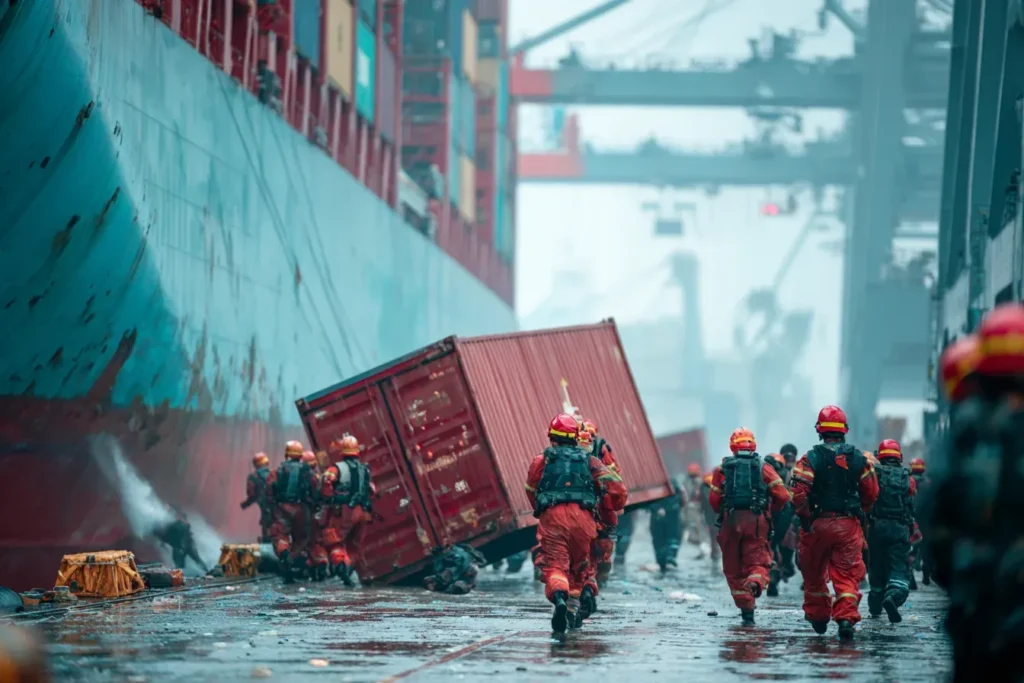
Among the common maritime injuries we handle, cargo ship accidents include falling containers that crush workers, crane failures that drop heavy loads, and gangway collapses during boarding. Lashing equipment failures cause containers to shift and strike workers. Slippery deck conditions from oil spills or weather create dangerous fall hazards.
Engine room accidents frequently involve burns from steam or hot surfaces, while cargo holds present risks from toxic fumes or oxygen-deficient atmospheres. Loading and unloading operations create hazards from moving machinery, pinch points, and unstable cargo stacks.
Who Is Covered: Jones Act Seamen vs Longshore Workers
Your legal rights depend entirely on your job classification and where the accident occurred. We analyze your work duties and accident location to determine which maritime laws provide the strongest protection for your specific situation.
Jones Act seamen are vessel crew members who spend substantial time aboard ships in navigation. This includes ship officers, engineers, deckhands, and other crew members. The Jones Act allows seamen to sue their employers for negligence and provides maintenance and cure benefits for daily living expenses and medical care.
Longshore workers handle cargo at ports and terminals but work primarily on land-based facilities. This includes longshoremen, crane operators, terminal workers, and stevedores. The LHWCA provides medical benefits and wage replacement, as well as the right to sue negligent vessel owners under Section 905(b).
Section 905(b) gives longshore workers injured by vessel negligence the right to file separate lawsuits against ship owners. This allows recovery of full damages, including pain and suffering, which are not available through LHWCA benefits alone.
What Laws Apply to Cargo Ship Injuries
Multiple federal maritime statutes may govern your case, each providing different types of compensation and having distinct requirements enforced by various agencies. Knowing who enforces maritime laws helps you understand the regulatory framework protecting your rights.
Understanding which laws apply determines the full scope of benefits available to you and your family.
| Law | Coverage | Primary Benefits |
| Jones Act | Vessel crew members | Employer negligence lawsuits, maintenance and cure |
| LHWCA | Dock and terminal workers | Medical care, wage replacement |
| Section 905(b) | Longshore workers hurt by vessels | Full damage lawsuits against vessel owners |
| DOHSA | Families of workers killed beyond 3 miles offshore | Wrongful death compensation |
The Jones Act applies to seamen injured due to employer negligence or unseaworthy vessel conditions. Maintenance and cure provides daily living allowances and medical care regardless of fault. The LHWCA covers harbor workers, providing benefits similar to workers’ compensation while also allowing additional claims against third parties.
The Death on the High Seas Act governs wrongful death claims when maritime workers die in accidents occurring more than three nautical miles from shore. This federal statute provides compensation for families that may not be available under state wrongful death laws.
Fixed Pier vs Vessel Status: Why Location Changes Your Claim
Whether your accident happened on the vessel itself or on the dock fundamentally alters your legal options and potential compensation. Courts examine the specific location and your work duties at the time of injury to determine applicable laws.
Accidents occurring on vessels may trigger Jones Act rights for crew members, including claims for unseaworthiness and employer negligence. Dock accidents typically fall under the LHWCA, though injured workers may have additional Section 905(b) claims against negligent vessels.
Gray areas exist on structures such as gangways, loading ramps, and where vessels connect to shore facilities. These transitional zones require careful legal analysis to determine whether vessel or shore-based laws apply to your specific accident.
What to Do After a Cargo Ship Accident
Taking proper steps immediately after an accident protects both your health and your legal rights. Focus on your medical needs while we handle the complex legal requirements and deadlines that could affect your compensation.
Get Medical Care and Report the Accident
Seek immediate medical attention for all injuries, even those that seem minor initially. Many maritime injuries worsen over time or involve delayed symptoms that appear days later. Document all medical treatment and follow your doctor’s recommendations completely.
Report your accident to your employer in writing within 30 days, as required by the LHWCA. This notice preserves your right to benefits and starts the claims process. Keep copies of all accident reports and medical records for your attorney.
Preserve Evidence and Identify Witnesses
Take photographs of the accident scene, the hazardous condition that caused your injury, and any visible injuries if you are able. Document container numbers, equipment involved, and environmental conditions at the time of the accident.
Obtain contact information for any crew members, dock workers, or other witnesses who witnessed the accident. Their testimony may be crucial for proving negligence and establishing liability against responsible parties.
Avoid Recorded Statements and Premature Forms
Do not provide recorded statements to insurance adjusters or sign settlement documents without consulting an attorney first. These tactics are designed to minimize your claim and limit the company’s liability for your injuries.
You have the right to choose your own doctor for medical treatment in most cases. Company doctors may prioritize the employer’s interests over your health and recovery needs.
Call a Cargo Ship Accident Lawyer
Contact an experienced maritime attorney immediately to protect your rights and begin building your case. We send preservation letters to all potential defendants, handle insurance communications, and coordinate proper medical care so you can focus on healing.
Who May Be Liable in a Cargo Ship Accident
Multiple companies often share responsibility for cargo ship accidents due to the complex operations involving various contractors and subcontractors. We investigate thoroughly to identify every party whose negligence contributed to your injuries.
Ship owners and operators may be liable for maintaining unsafe vessel conditions, providing inadequate crew training, or failing to follow proper safety protocols. Terminal operators can be responsible for dangerous dock conditions, defective equipment, or improper cargo handling procedures.
Stevedore companies that load and unload cargo may be liable for unsafe work practices, equipment failures, or inadequate worker training. Equipment manufacturers can be held responsible for defective cranes, lashing gear, containers, or other faulty products that cause accidents.
What Compensation Can You Recover
The amount and type of compensation available depend on which maritime laws apply to your case. We pursue all available remedies to secure the maximum financial recovery for your injuries and losses.
LHWCA benefits include all necessary medical treatment, two-thirds of your average weekly wage while you are unable to work, compensation for permanent disabilities, and vocational rehabilitation services if you cannot return to your previous job.
Jones Act and Section 905(b) claims allow recovery of full damages, including past and future lost wages, all medical expenses, pain and suffering, loss of life enjoyment, and, in rare cases, punitive damages for particularly egregious conduct.
Understanding average compensation amounts in California maritime cases can help injured workers evaluate their potential recovery.
- Medical Expenses: All reasonable and necessary treatment costs, both past and future
- Lost Wages: Full compensation for income lost due to your inability to work
- Disability Benefits: Payments for permanent impairments that affect your earning capacity
- Pain and Suffering: Compensation for physical pain and emotional distress caused by your injuries
How Long Do You Have to File
Maritime law imposes some of the strictest deadlines in personal injury law. Missing these time limits permanently bars your right to seek compensation, regardless of how strong your case might be.
You must notify your employer in writing within 30 days of your accident under the LHWCA. This notice requirement has limited exceptions and must include specific information about when, where, and how your injury occurred.
Formal LHWCA claims must be filed within one year of the injury date. Jones Act negligence claims are subject to a three-year statute of limitations. Section 905(b) claims against vessel owners typically must be filed within three years of the accident.
Evidence preservation becomes critical immediately after accidents. Surveillance footage may be automatically deleted, witnesses may become unavailable, and physical evidence can be altered or destroyed if you delay taking legal action.
Port of Los Angeles and Long Beach Cases We Handle
The Law Offices of Charles D. Naylor operates at the center of the nation’s busiest port complex. Our location provides immediate access to accident scenes and deep familiarity with terminal operations, union procedures, and the federal courts that handle these cases.
We represent injured workers in accidents involving container ships, bulk carriers, tankers, and other commercial vessels operating through these ports. Our experience includes cases against major shipping lines, terminal operators, and stevedore companies that handle cargo operations.
The Central District of California federal court in Los Angeles handles most maritime injury cases from these ports. Our attorneys regularly appear in this court and understand the local procedures, judges, and legal precedents that may affect your case.
Results and Recognition in Maritime Injury Law
Our decades of experience representing injured maritime workers have earned national recognition and substantial recoveries for our clients. While past results cannot guarantee future outcomes, they demonstrate our commitment to fighting for maximum compensation.
Charles D. Naylor has been repeatedly named a Southern California Super Lawyer and holds an AV Preeminent rating from Martindale-Hubbell, the highest available rating for professional excellence and ethics. He serves as an adjunct professor of admiralty law and contributes to legal education in the maritime field.
Our firm has secured substantial jury awards and settlements in wrongful death and serious injury cases, and has achieved numerous significant recoveries for injured maritime workers and their families.
Why Choose the Law Offices of Charles D. Naylor
When facing large shipping corporations and their insurance companies, you need attorneys with the experience and resources to level the playing field. Our firm is dedicated exclusively to maritime injury law.
Our location at the Port of Long Beach allows immediate response to accidents and on-site investigations while evidence is still available. We are not general practice attorneys learning maritime law on your case, but specialists who understand the industry, the laws, and the tactics companies use to minimize claims.
Insurance companies know we prepare every case for trial, which forces them to negotiate fairly rather than offering inadequate settlements. We work on a contingency fee basis, advancing all case costs so you pay nothing unless we win your case.
- Maritime Law Focus: Over five decades exclusively practicing admiralty and maritime injury law
- Strategic Location: Immediate access to the Port of Los Angeles and Long Beach accident scenes
- Trial Ready: Insurance companies know we will go to court if necessary to secure fair compensation
- No Upfront Costs: You pay no attorney fees unless we win your case
FAQs: Cargo Ship Accident Lawyer
Do I Qualify as a Jones Act Seaman if I Split Time Between Ship and Dock?
If you spend at least 30% of your work time on a vessel in navigation, you likely qualify as a Jones Act seaman with the right to sue your employer for negligence. Mixed-duty workers require individual case analysis to determine their proper legal classification.
Can a Longshore Worker Get LHWCA Benefits and Sue a Negligent Vessel Under Section 905(b)?
Yes, you can receive LHWCA benefits from your employer while simultaneously pursuing a separate Section 905(b) negligence lawsuit against the vessel owner for full damages. These are independent legal remedies that can be pursued together.
What Cargo Ship Evidence Should Be Preserved Right Away?
Critical evidence includes the Voyage Data Recorder, deck logs, cargo manifests, lashing certificates, inspection reports, and surveillance footage from the vessel or terminal. This evidence often gets destroyed or overwritten if not immediately preserved in response to legal demands.
Can I Still Hire a California Lawyer if I Was Repatriated After My Injury?
Yes, the Law Offices of Charles D. Naylor represents injured maritime workers worldwide and can handle your case even if you were sent home after the accident. We regularly work with clients who have returned to their home countries for medical treatment.
Where Will My Case Be Filed for a Port of Los Angeles or Long Beach Accident?
Most cases involving accidents at these ports are filed in the Central District of California federal court in Los Angeles. However, the specific venue depends on factors including where you live, where the accident occurred, and contractual provisions.
How Do Attorney Fees Work for Maritime Injury Cases?
We work on a contingency fee basis, meaning you pay no attorney fees unless we win your case. We also advance all litigation costs, including expert witness fees, court fees, and investigative expenses, so you have no out-of-pocket costs.
Contact the Law Offices of Charles D. Naylor
A cargo ship accident should not jeopardize your family’s financial security. We fight against large corporations and their insurance companies to secure the compensation you deserve under maritime law. Your consultation is free, confidential, and comes with no obligation.
Our attorneys are available to discuss your case and explain your rights under the Jones Act, LHWCA, and other maritime statutes. We handle all communications with insurance companies and employers while you focus on your medical recovery and returning to work.
Start protecting your rights today. Call (310) 514-1200 or contact us online for your free cargo ship accident case review.