Injured in maritime accident at the Port of Sacramento, CA? Contact the top Port of Sacramento accident attorney to seek justice today.
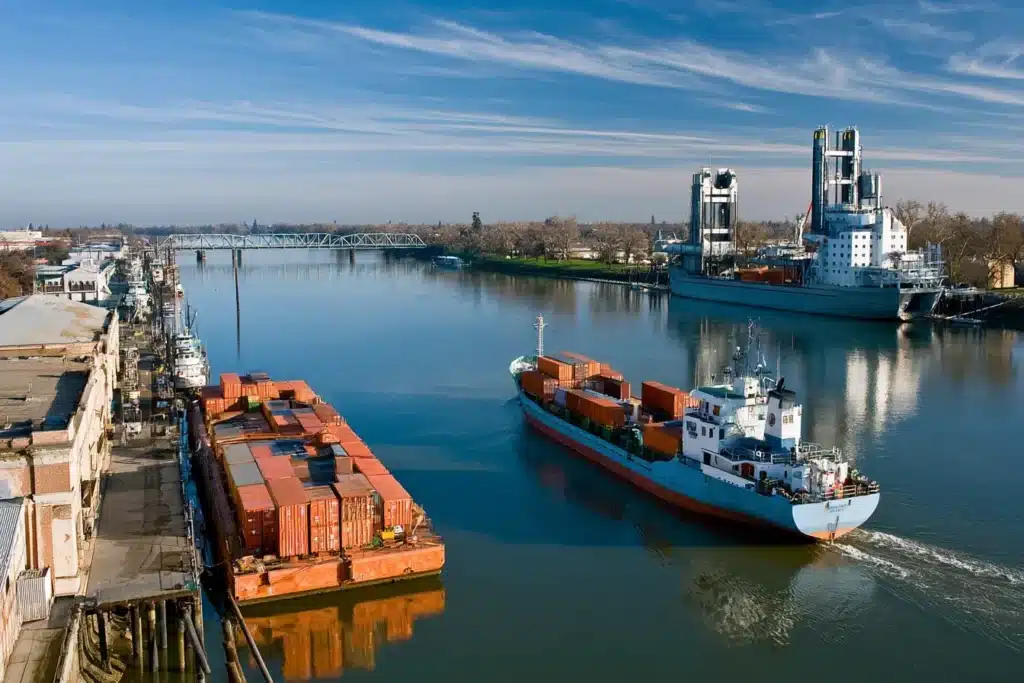
Bulk cargo terminals along the Sacramento Deep Water Ship Channel handle rice, cement, wood pulp, and steel every day of the year, and the workers who load, secure, and move that freight take on risks the average job site never sees.
When something goes wrong at the Port of West Sacramento, an injured worker is thrown into a legal system that looks nothing like a standard California workers’ compensation claim.
You need an attorney who understands maritime employment before you file anything, sign anything, or accept a benefit check that quietly waives your rights. Insurers for shipping lines, stevedoring outfits, and terminal operators know exactly which federal rules apply to your job and how to use them to pay you less.
We represent injured maritime workers, including longshoremen, deckhands, tugboat crews, and shipyard workers along the West Coast.
Contact our maritime injury attorneys based in California at (310) 514-1200. Your first conversation with us is free, and you owe us nothing unless we recover money for you.
Why Choose Law Offices of Charles D. Naylor?
Federal maritime law, not California personal injury law, governs your claim if you were hurt at the Port of Sacramento. The Jones Act, the Longshore and Harbor Workers’ Compensation Act (LHWCA), and related admiralty statutes carry their own deadlines, damage structures, and legal standards that general injury attorneys routinely miss or mishandle.
Our practice focuses exclusively on maritime and admiralty law. Charles D. Naylor was named the 2021 Admiralty & Maritime Law “Lawyer of the Year” in Los Angeles by Best Lawyers®.
Our record reflects what that level of specialized focus produces:
- $52.2 Million Jury Verdict: Secured for a seaman who suffered a catastrophic injury.
- $3.2 Million Settlement: Recovered for a Jones Act seaman harmed by unsafe conditions on the job.
- Contingency-Fee Representation: You pay nothing unless we win, no retainer, no hourly billing.
- 24/7 Free Injury Hotlines: Dedicated lines for seamen, longshoremen, and shipyard workers are available around the clock at no cost to you.
Who We Represent at the Port of Sacramento
The Port of West Sacramento moves bulk cargo through the Sacramento Deep Water Ship Channel, and every worker who keeps those operations running faces serious hazards on every shift. We represent:
- Longshoremen, stevedores, crane operators, and terminal mechanics
- Tugboat and barge crews, deckhands, and vessel officers
- Ship repair and shipyard workers along the Deep Water Ship Channel
- Harbor workers and on-terminal truck and rail workers
- Surviving family members pursuing a wrongful death claim
Your specific role determines which federal law governs your case and what you can recover.
Which Law Governs Your Claim?
This question controls everything, how you can sue, who you can target, and what damages are within reach. If you spend at least 30% of your working time on a vessel while it is in navigation, you are likely a Jones Act seaman. If you work primarily on the dock, terminal, or in a shipyard, the LHWCA most likely applies.
| Jones Act | LHWCA | |
| Who It Covers | Seamen assigned to a vessel | Dock, terminal, and shipyard workers |
| Pain and Suffering | ✓ Recoverable | ✗ Not available |
| Maintenance and Cure | ✓ Required | ✗ Not applicable |
| Sue Your Employer Directly | ✓ | ✗ Generally barred |
| Third-Party Vessel Claim | ✓ | ✓ Under § 905(b) |
Employers and their insurance carriers routinely misclassify workers to limit their financial exposure. We identify your correct classification from day one and fight to ensure you are not shortchanged by a label your employer assigned.
What Compensation Can You Recover?
In most maritime cases, you can pursue full medical expenses, all past and future lost wages, diminished earning capacity, and compensation for physical pain and suffering. The specific damages available depend on your worker classification.
Jones Act seamen are additionally entitled to maintenance and cure, a fundamental maritime benefit requiring your employer to cover your daily living costs and all reasonable medical bills until you reach maximum medical improvement. This obligation applies regardless of who was at fault. The daily rates employers typically offer are often far below what the law requires, and we fight to correct that.
Under the LHWCA, covered workers receive disability payments equal to two-thirds of their average weekly wage and full medical coverage through the federal workers’ compensation program. LHWCA workers can also file a third-party negligence lawsuit against the vessel where they were injured, which may recover pain and suffering damages the compensation program does not cover.
Families who have lost a loved one in a fatal port accident may bring a wrongful death claim under general maritime law or the Death on the High Seas Act (DOHSA).
Who Can Be Held Liable?
Your employer is rarely the only responsible party in a port accident. The vessel owner, terminal operator, stevedoring company, equipment manufacturer, and the Port of West Sacramento itself can all be held accountable depending on how your injury occurred.
A key doctrine in maritime law is unseaworthiness, a strict liability standard that holds vessel owners responsible whenever their ship, gear, or equipment was not reasonably fit for its intended use. Unlike a negligence claim, you do not have to prove the owner was careless to succeed on this theory.
We investigate every potentially liable party, from the vessel owner to the equipment manufacturer, to ensure no source of recovery is left off your claim.
Common Accidents We Handle at the Port of Sacramento
The Port’s combination of heavy machinery, confined spaces, and constant cargo movement creates hazards unlike any other job site. We handle cases arising from:
- Mooring Line Snapback: A line under tension that parts recoils with lethal force. Workers in the snapback zone can suffer fatal injuries before they have time to react.
- Crane and Rigging Failures: Defective slings, dropped loads, and poorly maintained cranes cause some of the most severe injuries seen at Sacramento terminals.
- Forklift and Yard Truck Collisions: Terminal tractors and top-picks operate in tight areas with serious blind spots, creating constant danger for workers on foot.
- Falls Aboard Vessels and on the Dock: Unsecured gangways, wet decks without non-skid surfacing, and open hatch covers send workers onto concrete or into vessel holds with devastating force.
- Confined Space and Chemical Exposure: Tanks, holds, and spaces with fumigation residues or oxygen deficiency can cause irreversible harm within minutes of entry.
How We Investigate Your Case
Evidence at a port accident scene disappears fast. A vessel can leave port before investigators arrive, digital logs can be overwritten, and crew members rotate off without notice.
We issue immediate legal preservation letters to prevent evidence from being destroyed and deploy our own investigators to the terminal or vessel while the trail is still fresh. We move to secure:
- Job Hazard Analyses (JHAs) and safety meeting records
- Vessel maintenance logs and inspection histories
- Terminal and vessel CCTV footage
- Voyage Data Recorder (VDR) electronic data
We then retain maritime safety experts, naval architects, and accident reconstruction specialists to build a precise, documented account of what went wrong and why the responsible party bears legal accountability for your injuries.
Steps to Take After a Port of Sacramento Injury
What you do in the first 48 hours can determine the outcome of your entire case. Shipping companies and their insurers protect themselves the moment an accident is reported, you need to do the same.
- Report in Writing and Get a Copy. Tell your supervisor immediately and ensure an official accident report is created. Do not sign any document from the company or its insurer without first speaking to an attorney.
- Choose Your Own Doctor. You are not required to use a company clinic or physician. An independent doctor works for your recovery and your claim, not your employer’s financial interests.
- Document the Scene. Photograph the equipment and your injuries as soon as possible. Get the names and contact information of any coworkers who witnessed the accident before they leave the terminal or vessel.
- Decline a Recorded Statement. Insurance adjusters use your words to find inconsistencies that reduce or deny your recovery. Politely decline and tell them your attorney will be in contact.
What Are the Deadlines to File a Maritime Claim?
A missed filing deadline permanently ends your right to seek compensation, no exceptions, no extensions. The applicable cutoff depends on your worker classification and who you are filing against:
- Jones Act and Unseaworthiness: Three years from the date of your injury.
- LHWCA: Written notice to your employer within 30 days, a formal claim filed within one year.
- Claims Against the Port of West Sacramento: As a public entity, the Port may require a Government Claims Act notice within six months of your accident, far shorter than any standard maritime deadline.
Even if your employer is currently paying your medical bills, these deadlines are already running. Contact us before your window closes.
What Does It Cost to Hire a Maritime Attorney?
You pay nothing upfront to work with us. We handle every maritime injury case on a contingency-fee basis, our fee is a percentage of what we recover for you, and only if we win.
If we do not win, you owe us nothing at all. We advance all case costs, including expert witnesses, court filing fees, and accident reconstruction, so financial pressure never forces you into a settlement that undervalues your injuries.
Call our 24/7 injury hotline at (310) 514-1200 for a free case review, no fee unless we win.
Will My Maritime Case Settle or Go to Trial?
Most maritime injury cases resolve through a negotiated settlement, but the size of that settlement depends directly on your attorney’s reputation for winning at trial. Shipping company insurers pay full value only when they believe your lawyer will take the case to a jury without hesitation.
We prepare every case for trial from day one. Our decades of courtroom victories at every level of maritime litigation, from administrative proceedings to federal jury trials, give us the leverage to negotiate a strong result without backing down under pressure.
Contact Our Maritime Injury Team for a Free Case Review
Our office is at 111 W. Ocean Blvd in Long Beach, at the heart of the Port of Los Angeles and Port of Long Beach, the busiest cargo complex in the Western Hemisphere. From there, we represent maritime workers throughout California, including those injured at the Port of West Sacramento, on vessels navigating the Sacramento Deep Water Ship Channel, and throughout the Sacramento-San Joaquin Delta waterway system.
We travel to clients and handle cases remotely when needed. Call (310) 514-1200 24/7 for a free, confidential case review, no obligation and no cost to you.
Frequently Asked Questions
Does Barge or Tugboat Work Qualify Me for Jones Act Coverage?
It can. If you spend at least 30% of your working time on a vessel in navigation and contribute to its mission, you likely qualify as a Jones Act seaman with full rights to pursue negligence, unseaworthiness, and maintenance and cure claims.
Can I Sue the Vessel Owner if I Already Receive LHWCA Benefits?
Yes. Under LHWCA Section 905(b), you can file a third-party negligence lawsuit against the vessel owner where your injury occurred, even while collecting workers’ compensation benefits from your direct employer.
What Happens if My Employer Refuses Maintenance and Cure Payments?
An employer who withholds or terminates maintenance and cure without justification can face punitive damages if a court finds the refusal was willful and unreasonable. We act immediately to restore those legally required payments when an employer cuts them off.
Do I Have to See the Company Doctor After a Port Injury?
No. Both the Jones Act and LHWCA give you the right to choose your own treating physician. Seeing a company-approved doctor first can produce a biased evaluation that gets used against your claim.
What Happens if My Employer Retaliates for an Injury Report?
Retaliation against a maritime worker for reporting a workplace injury is illegal. If your employer threatens your job, cuts your hours, or pressures you to stay silent, call us right away, specific federal protections apply to your situation.
How Long Does a Port of Sacramento Maritime Case Take to Resolve?
The time it takes to resolve a maritime injury case varies widely depending on whether liability is contested and whether the matter goes to trial. Catastrophic injury and wrongful death claims can take longer, but we work to reach the strongest possible result as efficiently as the case allows.