Injured in a maritime accident at the Port of San Francisco? Contact the top Port of San Francisco accident attorney to seek compensation.
If you were hurt boarding a cruise ship at Pier 27 or Pier 35, injured while working at the Port of San Francisco’s commercial terminals, or suffered an accident on city-owned pier property along the Embarcadero, you face deadlines and legal complexities that standard injury attorneys often miss.
The Port of San Francisco operates as both a major cruise terminal serving Princess, Carnival, Celebrity, and Norwegian lines, and a working commercial port with longshore operations, creating multiple overlapping jurisdictions under federal maritime law, state workers’ compensation rules, and local government claims requirements.
The maritime injury attorneys at the Law Offices of Charles D. Naylor understands these layered legal frameworks because we have practiced maritime law at California ports for over five decades. We handle the immediate preservation of ship CCTV footage, coordinate with federal maritime investigators, and navigate the specific venue requirements that each cruise line buries in its ticket contract.
Contact us to schedule a free consultation and discover how a Port of San Francisco accident attorney can help you seek the compensation and justice you deserve.
Why Port of San Francisco Accident Claims Are Different from Standard Injury Cases
A Port of San Francisco accident is not a typical slip and fall claim. Maritime law is a specialized area of federal law, and the rules that protect you are very different from what applies to a car accident or a workplace injury on land.
Several specific traps can eliminate your right to compensation if you are not aware of them:
- Forum selection clauses: Your cruise ticket may require you to file your lawsuit in Miami, Los Angeles, or Seattle, not in San Francisco where you were injured.
- Short notice requirements: Most cruise lines require written notice of your claim within six months of the accident.
- One-year filing deadlines: Cruise passengers typically have just one year from the date of injury to file a lawsuit, far shorter than California’s standard personal injury deadline.
- Longshore worker reporting rules: Under the Longshore and Harbor Workers’ Compensation Act, injured dock and terminal workers must report their injury to their employer within 30 days or risk losing benefits entirely.
- Government claim deadlines: If your accident happened on city-owned property along the Embarcadero, you may have only six months to file a formal government claim against the Port of San Francisco.
We know that cruise passengers have just six months to provide written notice and one year to file suit, longshore workers must report injuries within 30 days to preserve their federal benefits, and anyone hurt on city-owned property must file a government tort claim within six months. We respect these deadlines and we act immediately to protect every one of them.
What Counts as a Port of San Francisco Accident?
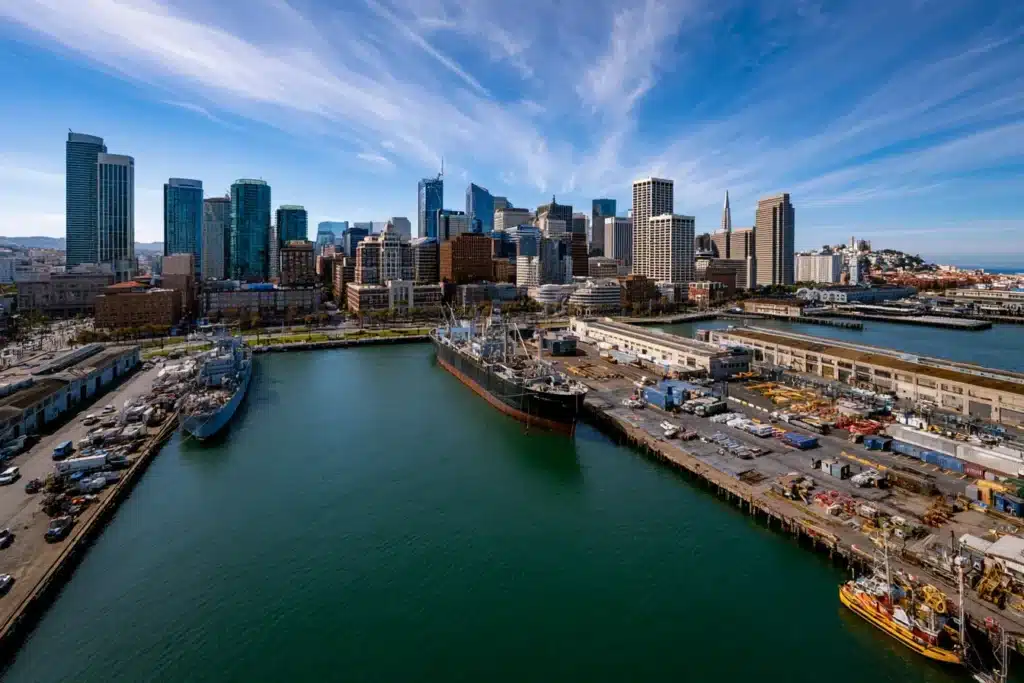
The Port of San Francisco operates primarily at Pier 27 and Pier 35 along the northern Embarcadero waterfront. It serves as a home port for Princess Cruises, Carnival Cruise Line, Celebrity Cruises, and Norwegian Cruise Line.
Accidents at this port happen in several common ways:
- Gangway falls, where a gangway is the ramp used to board or exit a ship, caused by steep angles, wet surfaces, or inadequate handrails
- Slip and falls on pool decks, interior staircases, and wet cabin corridors aboard cruise ships
- Injuries during shore excursions sold and organized by the cruise line
- Ferry and tour boat collisions or hard landings at the dock
- Longshore worker injuries involving falling cargo, cranes, and forklifts at commercial terminals
- Hazards on city-owned pier property, including uneven surfaces and poor lighting
A pattern we consistently see in gangway fall claims at Pier 27 and Pier 35 is that the cruise line’s incident report describes the gangway angle as within normal range without mentioning the tide level at the time of boarding, which directly affects how steep the ramp actually was.
We obtain the tide tables and gangway angle logs for the specific boarding time to establish the true condition passengers faced.
Who Is Protected Under Maritime Law at the Port of San Francisco?
Your legal rights depend on your specific role at the port. Federal maritime law covers several different groups of people, each under a different statute.
- Cruise and ferry passengers are protected by General Maritime Law, which holds cruise lines accountable for negligence aboard their vessels and in their terminals.
- Longshore and harbor workers are covered by the Longshore and Harbor Workers’ Compensation Act, which provides no-fault medical benefits and wage replacement, and also allows separate lawsuits against negligent third parties such as vessel owners.
- Vessel crew members who qualify as seamen under the Jones Act have the right to sue their employer directly for negligence, in addition to receiving maintenance and cure benefits.
- Surviving family members may bring wrongful death claims under General Maritime Law or the Death on the High Seas Act when a fatal accident occurs beyond three nautical miles from shore.
“Mr. Naylor is a great attorney, very experienced with workers comp cases, especially for longshore workers. His expertise with the Longshore and Harbor Workers’ Compensation Act, is the key. I would recommend his services to any worker in need of legal representation. His ‘no limit’ to service is a blessing. And his staff is to be commended also.” – Constance, LHWCA Client
What Laws Apply to Port of San Francisco Accidents?
| Law | Who It Covers | What It Provides |
| General Maritime Law | Cruise and ferry passengers | Negligence claims against vessel owners and cruise lines |
| Longshore and Harbor Workers’ Compensation Act | Dock and terminal workers | No-fault medical benefits, wage replacement, and third-party claims |
| Jones Act | Qualifying vessel crew members | Right to sue employer for negligence |
| California Government Claims Act | People injured on city-owned pier property | Path to sue a public entity, with a six-month filing deadline |
| Cruise Ticket Contract | All cruise passengers | Sets the required filing venue and a one-year lawsuit deadline |
Where Your Case Must Be Filed if Your Cruise Left San Francisco
This is one of the most misunderstood issues in cruise ship injury law. Even though your ship departed from San Francisco, your ticket contract almost certainly requires you to file your lawsuit somewhere else entirely.
Princess Cruises requires cases to be filed in Los Angeles. Carnival and Royal Caribbean require filing in Miami. Holland America requires filing in Washington state. We handle these out-of-state filings and associate with licensed local counsel when the court requires it.
Missing the required venue or the one-year deadline buried in your ticket permanently ends your right to recover compensation for your medical bills and lost income. We review your ticket contract immediately as part of your free case evaluation.
Steps to Take After a Port of San Francisco Accident
Step 1: Get Medical Care and Report the Incident in Writing
You must seek treatment and make sure the ship, terminal, or employer documents the incident in a written report. Get a copy of that report before you leave. Longshore workers must notify their employer within 30 days to preserve their rights under the Longshore and Harbor Workers’ Compensation Act.
Step 2: Photograph the Scene and Get Witness Contact Information
Take photos of the exact location, the hazard that caused your injury, and any visible injuries on your body. Collect names and phone numbers from anyone who witnessed the accident. Ship security footage can be overwritten quickly, so act promptly.
Step 3: Do Not Sign Anything or Give a Recorded Statement
Cruise line security staff and claims handlers may approach you in the ship’s medical center and ask you to fill out a passenger injury statement. These forms are designed to limit your claim. Do not sign any documents or give any recorded statement before speaking with an attorney.
Step 4: Call the Law Offices of Charles D. Naylor
We send formal legal preservation letters within 24 hours of being hired, demanding that the cruise line and terminal operator retain all CCTV footage, gangway logs, incident reports, and safety records. Early legal representation is the single most effective way to protect your claim.
Who May Be Liable for Your Port of San Francisco Accident?
Cruise Lines and Vessel Owners
Cruise lines owe passengers a duty to maintain reasonably safe conditions on their ships and gangways. When a wet deck goes unaddressed, a handrail is left broken, or a shore excursion vendor operates unsafely, the cruise line can be held liable for your medical costs and lost wages.
The Port of San Francisco and Other Public Entities
The City and County of San Francisco owns and operates significant pier infrastructure along the Embarcadero. If a defective surface, poor lighting, or an unsafe condition on city property caused your injury, you may have a claim against a government entity. These claims require a formal government tort claim filed within six months of the accident.
Terminal Operators, Contractors, and Equipment Manufacturers
Stevedoring companies, terminal operators, and equipment manufacturers can each be held responsible when their negligence injures a dock worker or passenger. Defective cranes, malfunctioning forklifts, and improperly secured cargo are common causes of serious injuries at working port terminals.
What we see across the Port of San Francisco claims we handle is that the Port and the terminal operator each point to the other when a hazard exists on city owned pier property along the Embarcadero, while cruise line staff maintain the incident happened before the passenger reached ship jurisdiction.
We name every entity connected to the location where you fell so a jurisdictional dispute between defendants does not delay your claim.
What Compensation Can You Recover?
The compensation available to you depends on which laws apply to your specific situation.
Longshore and Harbor Workers’ Compensation Act benefits include:
- All reasonable and necessary medical treatment
- Two-thirds of your average weekly wage during the period you cannot work.
- Permanent impairment awards for lasting disabilities
- Vocational rehabilitation if you cannot return to your prior occupation
- Death benefits for surviving dependents
Jones Act and third-party negligence claims allow you to recover:
- Full lost wages and future earning capacity
- All past and future medical expenses
- Compensation for physical pain and emotional suffering
- Loss of enjoyment of activities you can no longer perform
- Punitive damages in rare cases involving extreme or reckless conduct
Prior results do not guarantee a similar outcome.
“This was my first major injury and also first dealings with an attorney in this sort of case. The firm was exceptionally professional, well informed and knowledgeable of injury cases. They built my trust from the first interview and proved to be the perfect firm for me to use.
My attorney, Peter Forgie, is wonderful and kind, and an easy person to work with. My questions were answered and my concerns were treated as important. I was treated with respect. Thanks to all of you for your time and effort on my part. I really appreciate it!” – Darlene, Cruise Injury Client
How Long You Have to File a Port of San Francisco Accident Claim
- Cruise passenger lawsuits: Written notice within six months, lawsuit filed within one year
- Longshore and Harbor Workers’ Compensation Act claims: Employer notified within 30 days, formal claim filed within one year
- Government entity claims: Government tort claim filed within six months of the accident
- Jones Act claims: Three years from the date of injury
- Death on the High Seas Act claims: Three years from the date of death
Every day you wait increases the risk that security footage is deleted and witnesses become unreachable.
In our experience handling Port of San Francisco claims, clients are often surprised that a fall on city owned pier property near the Embarcadero requires a government tort claim within six months, a completely separate deadline from the one year cruise ticket requirement, and missing either one can end the case.
We calendar every applicable deadline the day we are retained so no filing window is missed.
Why Choose the Law Offices of Charles D. Naylor?
Charles D. Naylor has practiced maritime injury law exclusively for over 50 years in state and federal courts throughout California and beyond. He holds an AV Preeminent rating from Martindale-Hubbell, the highest professional and ethical rating available, and has been repeatedly named a Southern California Super Lawyer.
Our firm has secured substantial verdicts and settlements in longshore and cruise ship injury cases, including wrongful death, amputation, and serious slip-and-fall claims. Prior results do not guarantee a similar outcome.
We work on a contingency fee basis, meaning you pay nothing unless we recover compensation for you. You speak directly with the attorney handling your case, not a case manager.
“Charles Naylor and his staff are quick, brilliant and very persuasive no matter your side. He also has the unusual ability to keep you calm in all circumstances, which is very important. In the end he delivers, and more than you might expect. The best in maritime law that I’ve heard of and used! I owe him a thank you every month!” – JMK, Cruise Injury Client
Frequently Asked Questions About Port of San Francisco Accidents
Can I File a Lawsuit in San Francisco if My Cruise Ticket Requires Filing in Miami?
No. Forum selection clauses in cruise tickets are enforceable under federal maritime law. We handle the required out-of-state filing and work with local counsel in the required jurisdiction on your behalf.
How Quickly Is Ship Security Footage Deleted After a Gangway or Deck Accident?
Ship CCTV footage can be overwritten quickly unless a formal legal preservation demand is sent. We send that demand within 24 hours of being hired.
Can a Longshore Worker Collect Benefits and Also Sue a Negligent Vessel Owner?
Yes. The Longshore and Harbor Workers’ Compensation Act allows you to receive no-fault benefits from your employer and simultaneously pursue a separate negligence lawsuit against a third party such as a vessel owner under Section 905(b).
Does Maritime Law Apply if I Was Injured on the Pier Rather Than on the Ship?
It depends on whether the pier is covered by the Longshore and Harbor Workers’ Compensation Act or qualifies as a maritime location under General Maritime Law. If the pier is city-owned, the California Government Claims Act may also apply. We determine the correct legal framework during your free case evaluation.
Do I Have to Use the Ship’s Doctor for My Treatment?
You have the right to seek your own independent medical care once you are ashore. We can help connect you with physicians experienced in treating and documenting maritime injuries.