Injured in maritime accident at the Port of Stockton, CA? Contact the top Port of Stockton accident attorney to seek compensation today.
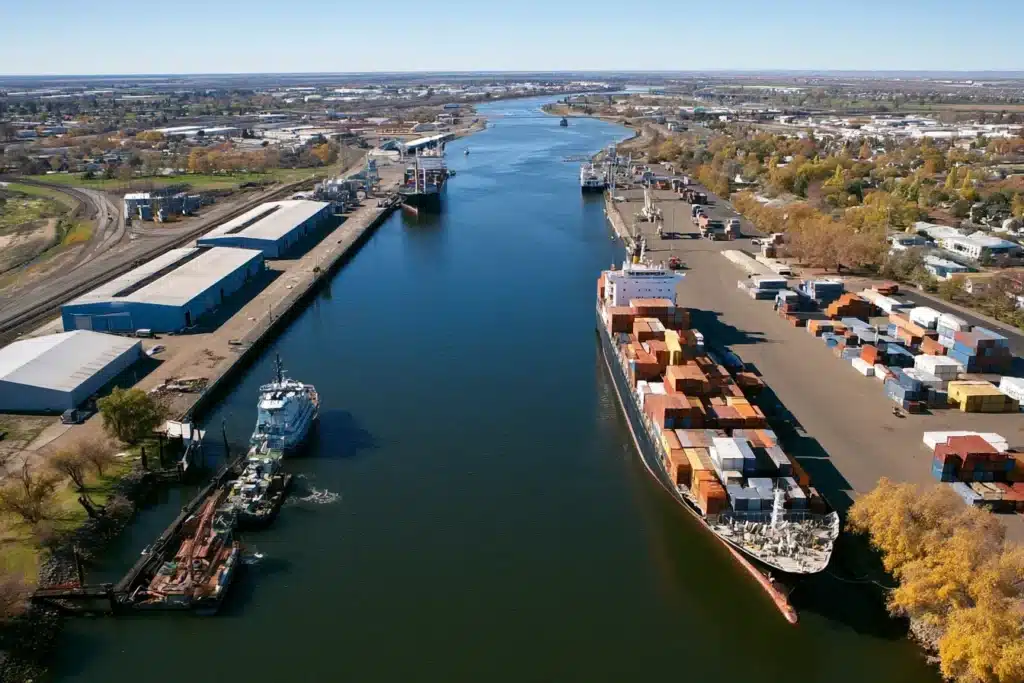
The Port of Stockton sits 75 nautical miles inland from the Golden Gate, connected to the Pacific by the San Joaquin River. It is an inland deepwater port that moves cement, sulfur, fertilizer, iron and steel, wind‑turbine components, and bulk agricultural cargo through terminals including Rough and Ready Island and the West Complex.
The work is heavy, the equipment is unforgiving, and the men and women who load these ships face hazards that have far more in common with the docks in San Pedro than with any land-based job in San Joaquin County.
That distinction matters the moment you are hurt. Federal admiralty law reaches every acre of Port of Stockton property that touches the water, and it governs the tugs, barges, and deep-draft ships that call there. If you were injured working cargo, operating a crane, crewing a river tug, or repairing a vessel at the Port, your case belongs in the hands of a firm that tries maritime cases for a living.
The Law Offices of Charles D. Naylor is based in California represents injured maritime workers on California’s waterfronts and beyond. We handle Port of Stockton cases from our Long Beach office and travel to clients throughout the state. Call (310) 514-1200 for a free, confidential consultation with a maritime attorney before you speak with your employer’s adjuster or the vessel owner’s insurer.
What to Do First after a Port of Stockton Injury
An accident on the Port of Stockton’s docks or aboard a vessel in the San Joaquin River is a federal maritime injury, not a standard California workers’ compensation claim. The laws that apply are more complex, the deadlines are shorter, and the mistakes that destroy cases often happen in the first few days.
- Get medical care immediately: Document every appointment, every diagnosis, and every treatment you receive. Adjusters working for vessel owners and stevedoring companies look for any gap in your medical record and use it to argue your injury is exaggerated or unrelated to the incident.
- Report your injury in writing: A verbal report to a supervisor can be forgotten or denied. The specific deadline for written notice depends on which federal statute covers your job, failing to meet it can bar your claim entirely.
- Preserve evidence before it disappears: Vessel logs, dock CCTV footage, crane maintenance records, and Job Safety Analysis sheets are routinely destroyed or overwritten within days of an accident. Once that evidence is gone, it cannot be recovered.
- Do not give a recorded statement: You are not legally required to speak on the record with your employer’s adjuster or the vessel owner’s insurer. They are trained to use your words against you, decline until you have consulted a maritime attorney.
Call (310) 514-1200 any time, day or night, before you speak with anyone representing the company.
Which Law Applies to Your Port of Stockton Injury?
Your legal rights after a Port of Stockton injury depend entirely on your job classification at the moment you were hurt. Two primary federal statutes govern most maritime injuries here, and the differences between them are significant.
| Statute | Who’s Covered | What You Can Recover |
| Jones Act | Seamen and crew members who contribute to the function of a vessel in navigation | Medical costs, lost wages, pain and suffering, emotional distress |
| LHWCA | Longshoremen, crane operators, harbor workers, and shipbuilders injured over navigable waters | Medical treatment and disability benefits; pain and suffering generally not available |
| CA Workers’ Comp | Land-based port employees not working over navigable waters | Medical care and disability payments under state law limits |
Employers and vessel owners routinely fight to have injured workers classified under the statute that limits what they owe the most, and a general practice attorney unfamiliar with admiralty law may never recognize that fight is happening, let alone win it. We have handled misclassification disputes throughout California and know how to identify the correct statute and fight for it.
Who Can Be Held Liable?
Responsibility for a Port of Stockton accident rarely rests with a single party, and identifying every liable company is essential to recovering full compensation.
- Vessel owners and operators: Liable for unseaworthiness, a legal term meaning the ship, its gear, or its crew was not reasonably fit for its intended use, whether that means defective rigging, poor lighting below deck, or an undertrained crew member.
- Stevedoring companies: Liable for negligent cargo handling, improper lashing and stowage, or failure to enforce safe work procedures during loading and discharge operations.
- Terminal operators: Liable for hazardous conditions on Port property, including defective forklifts, uneven dock surfaces, or poorly maintained equipment.
- Equipment manufacturers: Liable when cranes, winches, lines, slings, or lifting gear fail under normal working loads due to a design or manufacturing defect.
- Third-party contractors: Liable for negligence by outside companies working aboard a vessel or on the terminal that injures workers employed by another company.
When more than one party shares responsibility, which is common at a commercial port, we pursue each of them and do not let companies point fingers at each other to reduce what you recover.
What Damages Can You Recover?
The compensation available to you covers both what the injury has cost you financially and what it has taken from you as a person.
Economic damages include all past and future medical expenses, wages lost while you were unable to work, and any permanent reduction in your earning capacity. If your injuries prevent you from returning to your trade, we work with vocational and economic experts to calculate that loss across your entire working life.
Pain and suffering are available to Jones Act seamen and in certain third-party claims under general maritime law. It is not available under the LHWCA, which is one of the primary reasons your legal classification has such a direct impact on the total value of your case.
Maintenance and cure is a benefit Jones Act seamen are owed regardless of who caused the accident. “Maintenance” is a daily living stipend your employer must pay while you recover, and “cure” covers your medical treatment until a doctor determines you have reached maximum medical improvement, employers who delay or withhold these payments face additional penalties under maritime law.
What Deadlines Apply to a Port of Stockton Injury Claim?
Maritime deadlines are shorter and more rigid than most people expect, and they are entirely separate from California’s standard personal injury timelines.
- Jones Act: Three years from the date of injury to file a lawsuit
- LHWCA: Written notice to your employer within 30 days, formal claim filed with the U.S. Department of Labor within one year
- Government-owned terminal: A government tort claim may be required within just six months of the accident
If a general practice attorney tells you that California’s two-year personal injury deadline applies to your Port of Stockton case, they are applying the wrong law. Missing the deadline that actually governs your claim permanently ends your right to recover.
Common Port of Stockton Accidents
The Port handles bulk agricultural exports, cement, steel, lumber, and oversized project cargo, work that involves powerful machinery, extreme loads, and conditions where a single equipment failure can be fatal.
Accidents our firm handles include:
- Mooring line snapback injuries when lines under extreme tension suddenly part and recoil
- Crane and rigging failures during vessel loading and discharge operations
- Falls into open cargo holds or between the ship and the dock face
- Forklift, yard truck, and container handler accidents on terminal pavement
- Agricultural chemical and fumigant exposure during cargo handling
- Tugboat and barge crew injuries on the San Joaquin River
- Injuries during dry-dock and repair operations at port facilities
These accidents produce life-altering injuries, traumatic brain injuries, amputations, and spinal cord damage, that affect maritime workers and their families for the rest of their lives.
Where Your Case Will Be Filed
Jones Act claims can be brought in San Joaquin County Superior Court or the U.S. District Court for the Eastern District of California. LHWCA claims are handled through an administrative process at the U.S. Department of Labor, an entirely separate path from civil court.
Where your case is filed affects its timeline, the procedural rules that apply, and the leverage you hold at the settlement table. Choosing the right venue is a strategic decision, and we litigate maritime injury cases in both state and federal courts throughout California.
Call (310) 514-1200 for a free case review, we represent Port of Stockton injury clients statewide from our Long Beach office.
Why Choose Law Offices of Charles D. Naylor for Your Port of Stockton Case?
Our firm maintains an office on the Long Beach waterfront near the Ports of Los Angeles and Long Beach. We have long represented maritime workers against vessel owners, stevedoring companies, and P&I insurers, the maritime equivalent of liability insurance carriers, who may be on the other side of your case.
Charles D. Naylor is an experienced Admiralty & Maritime Law attorney based in Los Angeles. Our team has extensive experience handling maritime injury cases of every complexity, from maintenance and cure disputes to multi-party wrongful death actions.
Our proven track record gives our demands weight: we have secured favorable verdicts and settlements for maritime workers throughout California. When vessel owners and their insurers see our name on a claim, they know we are prepared to try the case to verdict, because every case we take is on contingency, meaning you pay nothing unless we win.
Port of Stockton Accident FAQ
Can I Recover Compensation If I Was Partly at Fault for My Accident?
Yes. The Jones Act applies a pure comparative negligence standard, meaning your damages are reduced proportionally to your share of fault, but you are not barred from recovering even if you contributed to the accident.
Am I a Jones Act Seaman If I Work on a Tug or Barge on the San Joaquin River?
You likely qualify if you spend roughly 30% or more of your working time contributing to the mission or operation of a vessel in navigation. Your specific duties and the nature of the vessel determine the final answer, and we can evaluate your situation in a free case review.
Do I Have to Use the Company’s Doctor?
While an employer may require an initial evaluation by their designated physician, both the Jones Act and the LHWCA protect your right to choose your own treating doctor for ongoing care.
What If the Port Terminal That Injured Me Is Government-Owned?
A formal government tort claim may be required within six months of the accident before you can bring a lawsuit, missing that deadline can permanently extinguish your right to recover, regardless of how clear the negligence is.
Does the LHWCA Cover Injuries That Happen Aboard a Vessel?
Yes. The LHWCA applies to injuries on navigable waters, which includes boarding, working on, or leaving a vessel, not only injuries that happen on the dock itself.
What Does It Cost to Hire Your Firm?
Nothing upfront. We advance all case costs, marine surveyor inspections, expert witness fees, court filing costs, and collect our fee only if we win your case.
Free 24/7 Maritime Case Review
The vessel owners and stevedoring companies involved in your case had maritime lawyers on retainer before you were ever injured. You deserve that same level of advocacy, whether you are a longshoreman, a tug crew member, or a shipyard worker.
Call (310) 514-1200, free and confidential, any time of day or night. We are located at 111 W. Ocean Blvd., Long Beach, CA, and we represent injured maritime workers throughout California.