Injured in a lifeboat or tender accident in California? Contact the top lifeboat accident lawyer to seek justice and compensation.
Lifeboats and tenders are among the most dangerous pieces of equipment on any ship. The davit systems that lower them weigh thousands of pounds, operate under constant saltwater corrosion, and rely on release hooks and brake mechanisms that fail in predictable ways when maintenance is deferred. When one of those systems fails during a drill, an evacuation, or a shoreside transfer, the people inside have no warning, and the vessel owner and cruise line begin protecting themselves immediately.
At the Law Offices of Charles D. Naylor, our maritime injury attorneys have experience representing people injured due to lifeboat accidents. The laws that govern each group are entirely different. A seaman injured when a davit brake seizes has rights under the Jones Act, the unseaworthiness doctrine, and maintenance and cure, while a passenger thrown from a tender is bound by a passage contract that cuts the filing window to one year. We know which rules apply and how to act inside the deadlines each one imposes.
Contact us today at (310) 514-1200 for a free consultation and discover how our lifeboat accident attorneys can help you seek the compensation and justice you deserve.
What Is a Lifeboat Accident?
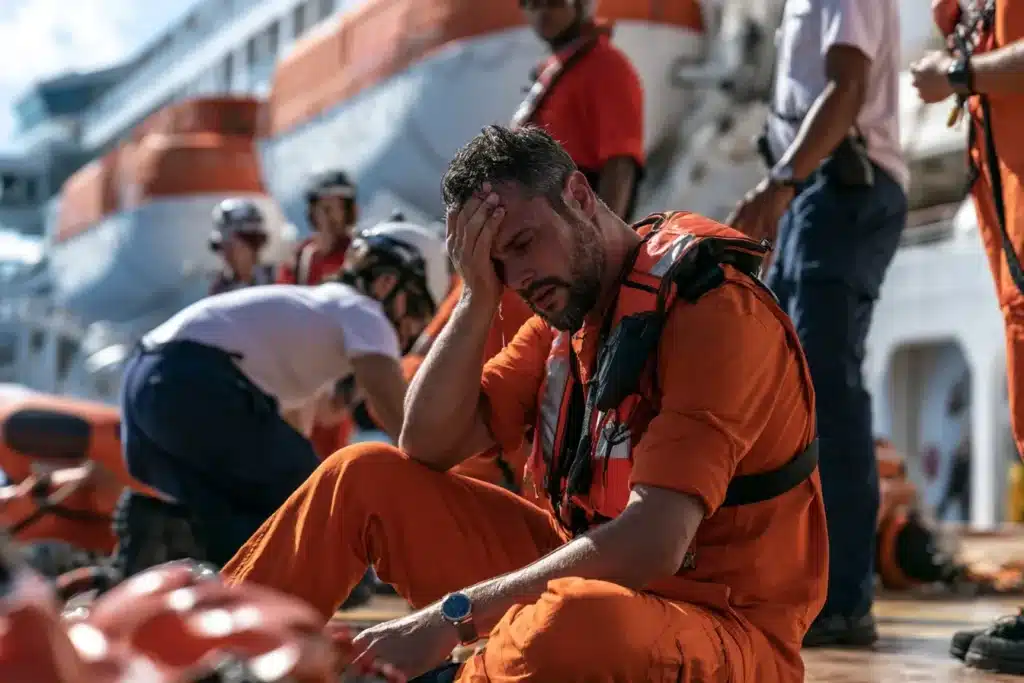
A lifeboat accident is any injury or death caused by the launching, lowering, boarding, or operation of a lifeboat, rescue craft, or tender, including the davit systems (the crane-like mechanisms that raise and lower the boats), fall wires, and release hardware that control them. These incidents injure and kill crew members during routine drills just as frequently as they harm passengers during shoreside transfers.
The legal distinction between a lifeboat and a tender matters for your claim. Lifeboats are survival craft designed for emergency evacuations. Tenders are smaller boats cruise lines use to ferry passengers from an anchored ship to a port or beach. Both carry serious injury risk under open water conditions, and both fall within the reach of federal admiralty law.
Who Is Liable for a Lifeboat or Tender Accident?
Liability can rest with the vessel owner, an equipment manufacturer, or a third-party contractor, and in many accidents, more than one party shares fault. Identifying the right defendants requires a fast investigation before ships sail and evidence disappears.
Vessel Owners and Operators
A vessel owner has a legal duty to maintain all life-saving equipment in working order and to ensure crew members are properly trained to operate it. Deferred maintenance on davit brakes, inadequate crew training records, and unrealistic pressure to complete drills quickly are the patterns we see driving most of these accidents.
Equipment Manufacturers and Service Contractors
Defective on-load release hooks, the mechanisms designed to free a lifeboat from its suspension wires only after it is waterborne, have caused some of the most catastrophic drops in modern maritime history. If a manufacturer supplied a defective component, or if a service contractor failed to perform required load testing, we pursue them alongside the vessel owner.
One pattern we consistently see in lifeboat drill injuries on ships calling at the Port of Long Beach and the World Cruise Center in San Pedro is that the drill was rushed to fit a tight port schedule. Crew members describe being told to lower and recover the boats faster than the procedures allow. We request drill logs and the ship’s maintenance records for the davit and release gear as soon as we are retained, before the vessel leaves port.
Port Agents and Shore-Side Operators
Tender accidents frequently involve third parties with no connection to the ship’s crew at all. A poorly secured floating dock, an unstable boarding ladder, or a contracted operator who misjudges wave conditions can seriously injure passengers who had every reason to expect a short trip to shore was safe.
What we see in tender injury cases is that passengers are often hurt at tender ports like Avalon on Catalina Island or Cabo San Lucas, where the tender lands at a local dock. Even when the injury happens outside the United States, the cruise line’s ticket usually requires the lawsuit to be filed in a specific U.S. federal court. We look at both the cruise line and any shoreside operator so the claim is not lost in the space between them.
What Laws Cover Injured Crew Members?
Seamen are not covered by state workers’ compensation. Under federal maritime law, three distinct, overlapping remedies are available, and an experienced admiralty attorney pursues all three simultaneously.
The Jones Act
Jones Act (46 U.S.C. § 30104) gives any seaman the right to sue their employer directly for negligence. The causation standard is deliberately forgiving: your employer’s negligence only needs to have played any part, even the slightest in causing your injury. Congress wrote it that way because it recognized how exposed workers are when they are hundreds of miles from shore with no other recourse.
Unseaworthiness
Unseaworthiness is a claim under general maritime law that requires no proof of negligence. A vessel owner is strictly liable when the ship or its equipment is not reasonably fit for its intended purpose. A lifeboat with corroded fall wires, a missing fall preventer device (FPD) (a secondary safety cable that prevents the hook from opening prematurely), or an improperly serviced release hook creates an unseaworthy condition that triggers liability regardless of intent.
Maintenance and Cure
Maintenance is a daily living stipend. Cure is the obligation to cover all reasonable medical costs. Your employer owes you both from the day you are injured in the vessel’s service until a physician determines you have reached maximum medical improvement, regardless of fault.
In our experience, maintenance payments offered to injured crew members are often set far below the actual cost of living in Southern California. A daily rate that might cover expenses elsewhere does not cover rent and food in Long Beach or San Pedro. We push for a maintenance rate based on your real living expenses, and we challenge any early cutoff of cure before your doctor says you have reached maximum medical improvement.
What Rights Do Cruise Passengers Have?
The ticket you purchased is a legally binding contract with provisions specifically designed to limit the cruise line’s exposure. Most passengers never read it, and that is precisely what cruise lines count on.
Ticket Deadlines and Venue Clauses
Nearly every major cruise line requires written notice of your injury within six months and a filed lawsuit within one year. Courts enforce these deadlines without exception. Your ticket also designates a specific federal court, often in Miami or Los Angeles, as the only permitted venue for your lawsuit, regardless of where you live or where the accident occurred.
DOHSA in Fatal Lifeboat Cases
When a lifeboat accident on open water results in a passenger’s death, the Death on the High Seas Act (DOHSA) governs the family’s claim. DOHSA applies when a death occurs more than three nautical miles from U.S. shores and limits recoverable damages to demonstrable economic losses. No compensation for grief or loss of companionship. That restriction makes rigorous documentation of every financial loss essential from the outset.
Common Causes of Lifeboat and Tender Accidents
In our experience representing injured mariners and passengers, we observe recurring patterns of equipment failure and human error:
- Premature release hook activation: An on-load hook opens while the lifeboat is still suspended high above the water, causing a sudden free fall with no warning for the crew inside.
- Davit arm and wire rope failure: Corroded davit arms, worn fall wires, and seized brake mechanisms produce uncontrolled descents or violent impacts against the hull.
- Drill and muster injuries: Inadequately supervised drills conducted under time pressure produce fractures, crush injuries, and overboard falls.
- Tender boarding accidents: Passengers fall crossing between a moving tender and the ship’s gangway ladder, or tenders collide with docks in building swells.
The injuries in these cases are severe. Traumatic brain injuries, spinal fractures, amputations, and drowning or hypothermia from open-water incidents are all outcomes we have handled for clients and their families.
What to Do after a Lifeboat Accident
Vessel owners and their insurers begin building a defense within hours of an accident. Your actions in the first day can shape the outcome of your entire claim.
- Get documented medical care: Do not rely on the ship’s infirmary alone. Insist on a written record of every injury, even symptoms that seem minor, because concussions and spinal injuries frequently worsen in the days following the incident.
- Report, but protect yourself: File an incident report with ship authorities, but do not give a recorded statement or sign any document from the employer or cruise line without speaking to a maritime attorney first.
- Preserve evidence while you can: Photograph the lifeboat, davit, release gear, and any visible damage. Write down the names and contact information of every crewmate or passenger who witnessed the accident.
- Call a maritime attorney the same day: Equipment gets repaired, logbooks disappear, and vessels sail away. We can seek court orders to preserve critical evidence, but only if we are retained before that window closes.
What Compensation Can You Recover?
Medical Costs and Lost Earning Capacity
You are entitled to recover the full cost of all treatment caused by the accident, including surgeries, rehabilitation, specialist care, and anticipated future medical needs. If your injuries permanently limit or end your career at sea, the earning capacity you lose across your remaining working years is also fully recoverable.
Pain, Suffering, and Loss of Enjoyment
Maritime law allows recovery for physical pain, emotional distress, and the daily limitations a serious injury imposes on your life. For a seaman whose livelihood and identity are defined by the water, a disabling injury carries costs no medical bill will fully reflect, and our job is to make sure those costs are presented in full to a jury or at the settlement table.
We have secured results, including $55.2 million jury award, a $3.2 million settlement, and numerous other six-figure recoveries. We build every case as though it is going to trial, because that level of preparation consistently produces the highest recoveries.
“Charles Naylor and his staff are quick, brilliant and very persuasive no matter your side. He also has the unusual ability to keep you calm in all circumstances – which is very important. In the end he delivers – and more than you might expect. The best in maritime law that I’ve heard of and used! I owe him a thank you every month!” – JMK, Cruise Injury Client
Deadlines That Apply to Your Claim
Missing a filing deadline ends your claim permanently. No exceptions. The deadline that governs your case depends entirely on your legal status at the time of the accident.
| Claim Type | Notice Required | Filing Deadline |
| Jones Act (seaman) | None | 3 years |
| DOHSA (wrongful death at sea) | None | 3 years |
| Cruise passenger (typical ticket) | 6 months written | 1 year |
| LHWCA (harbor worker) | 30 days to employer | 1 year |
Cruise passenger deadlines are far shorter than most people expect. The six-month written notice requirement alone has permanently extinguished otherwise valid claims before they ever reached a courtroom.
Why Hire Law Offices of Charles D. Naylor?
We have practiced admiralty and maritime law since 1974 from our offices at 111 W. Ocean Blvd in Long Beach, at the crossroads of the Ports of Los Angeles and Long Beach, the busiest cargo complex in the Western Hemisphere. Charles D. Naylor has been recognized by Best Lawyers® for his work in admiralty and maritime law and was named one of California’s Attorneys of the Year, and our team brings decades of combined maritime legal experience.
We handle cruise passenger cases in every federally designated venue nationwide, so you do not need to find separate local counsel in a distant city. We work on a contingency-fee basis, you pay nothing unless we win, and our free injury hotlines are available for cruise passengers, seamen, longshoremen, and shipyard workers.
“Working with Mr. Charles Naylor and George Jones was reassuring and highly professional. I definitely would like to thank them for their efforts, as well as (my paralegal) Gladis Morales.” – F.G., Cruise Injury Client
FAQ
Can I File a Claim if I Was Injured During a Lifeboat Drill?
Yes. Crew members injured during routine drills have full rights under the Jones Act and the unseaworthiness doctrine, the same rights that apply in a live emergency evacuation.
Who Pays a Seaman’s Medical Bills While the Case Is Pending?
Your employer is legally obligated to pay maintenance and cure from the date of your injury through maximum medical improvement, regardless of fault and regardless of how long the legal process takes to resolve.
What if a Defective Lifeboat Release Hook Caused the Drop?
A defective release mechanism creates both an unseaworthiness claim against the vessel owner and a separate product liability claim against the manufacturer. We pursue both simultaneously to maximize your recovery.
Where Must a Cruise Passenger File a Lifeboat Injury Lawsuit?
Your passage contract designates the specific federal court, typically in South Florida, Los Angeles, or Seattle, and we are prepared to litigate in all designated venues nationwide.
How Long Does a Cruise Passenger Have to File a Lifeboat Injury Claim?
Most cruise tickets impose a one-year filing deadline and require written notice within six months of the accident, and both are strictly enforced with no discretion for extension.
Get a Free Case Review
If you or a family member has been injured in a lifeboat or tender accident, call our maritime injury hotline at (310) 514-1200 or contact us online. The decisions you make in the first days after an accident determine what your case is worth, do not make them without experienced admiralty counsel. You pay nothing unless we win.